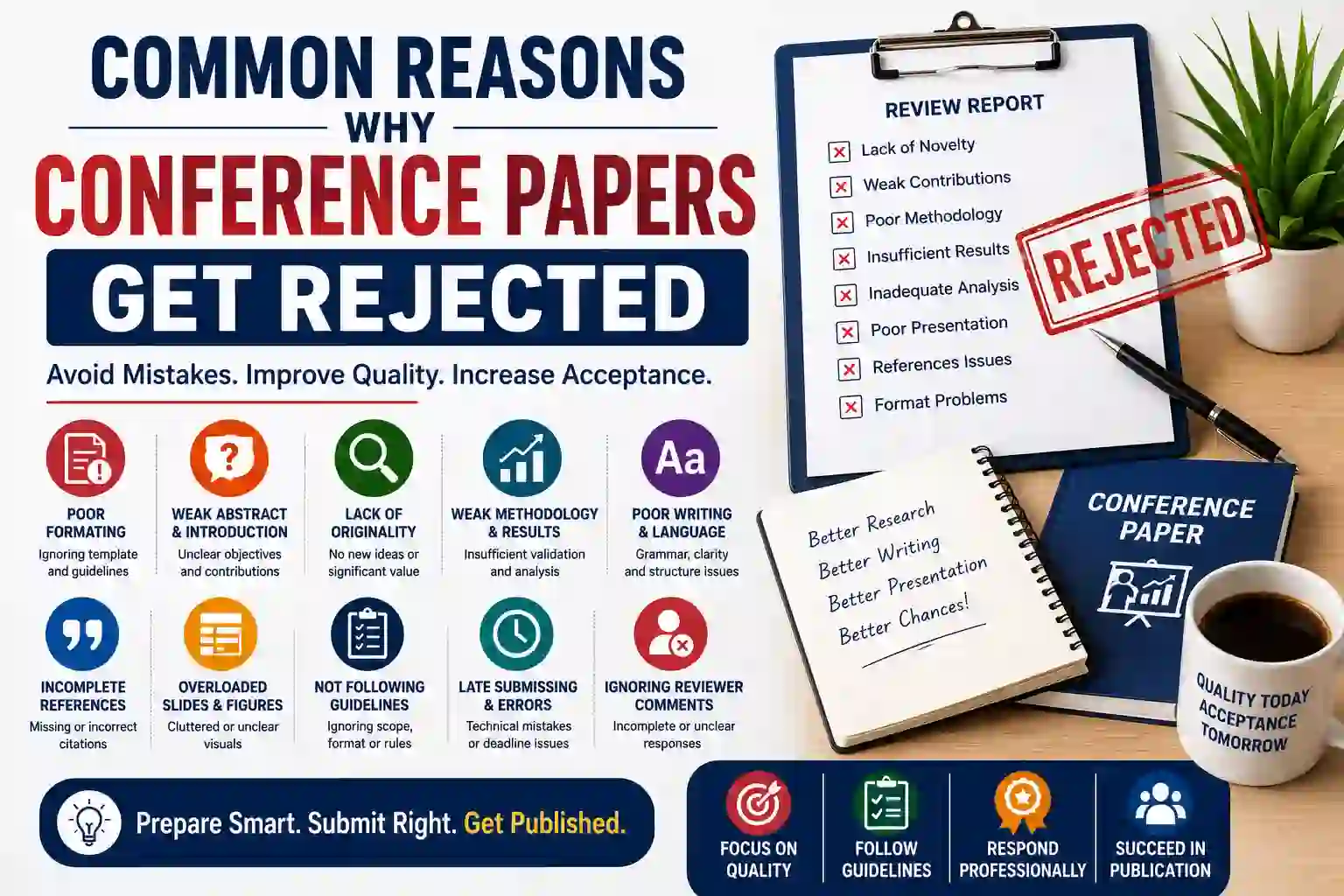
Submitting a research paper to an international conference requires much more than strong technical knowledge. Many research papers are rejected every year because of avoidable mistakes related to formatting, originality, presentation quality, weak methodology, or failure to follow conference guidelines.
Understanding the common reasons behind conference paper rejection can help researchers improve manuscript quality, satisfy reviewer expectations, and increase the chances of publication acceptance.
Researchers looking for authentic conference publication opportunities can explore ICETMS International Conference Platform .
Why Understanding Paper Rejection Is Important
Conference paper rejection is a normal part of academic publishing, especially in competitive international conferences. However, understanding reviewer expectations helps researchers strengthen future submissions and improve publication success.
Learning from rejection helps researchers:
- Improve research quality
- Enhance paper presentation
- Reduce technical mistakes
- Strengthen methodology
- Increase reviewer confidence
- Improve acceptance opportunities
1. Poor Paper Formatting
One of the most common reasons for rejection is failure to follow conference formatting guidelines.
Formatting mistakes include:
- Incorrect margins
- Improper font size
- Missing sections
- Incorrect references
- Broken equations
- Low-quality figures and tables
Reviewers often interpret poor formatting as lack of professionalism and insufficient preparation.
Researchers can improve manuscript structure through Best Practices for Conference Paper Formatting .
2. Weak or Unclear Abstract
The abstract is often the first section reviewers read. A weak abstract can immediately reduce reviewer interest in the paper.
Common abstract problems include:
- Unclear objectives
- Missing research contribution
- Vague methodology
- No meaningful results
- Poor writing quality
A strong abstract should clearly summarize the research problem, methodology, findings, and significance.
Researchers can improve abstract quality through How to Write Abstract for International Conference .
3. Lack of Originality
International conferences prioritize original and innovative research contributions. Papers with limited novelty are frequently rejected.
Common originality issues include:
- Repetitive research topics
- Minor modifications to existing work
- Insufficient innovation
- Weak technical contribution
Researchers should clearly explain what makes their work unique and valuable.
4. Plagiarism and Ethical Issues
Plagiarism is one of the most serious reasons for conference paper rejection.
Most conferences use plagiarism detection tools before peer review.
Common ethical problems include:
- Copied content
- Improper citations
- Duplicate publication
- Self-plagiarism
- Manipulated data
Researchers should always maintain academic integrity and proper citation practices.
5. Weak Research Methodology
Reviewers carefully evaluate whether the research methodology is technically valid and scientifically reliable.
Common methodology problems include:
- Insufficient experiments
- Weak dataset selection
- Poor evaluation metrics
- Lack of comparative analysis
- Unclear algorithms
- Unsupported conclusions
Strong methodology improves technical credibility and reviewer confidence.
6. Poor Grammar and Writing Quality
Even high-quality research may face rejection if the writing quality is poor.
Common writing issues include:
- Grammar mistakes
- Spelling errors
- Unclear sentences
- Poor academic language
- Inconsistent terminology
Professional proofreading is essential before final submission.
7. Weak Literature Review
A poor literature review suggests limited understanding of existing research.
Reviewers expect authors to:
- Cite recent research
- Identify research gaps
- Compare previous work
- Explain research relevance
Insufficient literature review reduces research credibility and technical depth.
8. Submitting to the Wrong Conference
Many papers are rejected because the research topic does not match the conference scope or themes.
Before submission, researchers should carefully verify:
- Conference themes
- Technical tracks
- Research domains
- Publication areas
Researchers can verify conference scope through International Conference Website for Conference Paper Publication .
9. Weak Results and Analysis
Conference reviewers expect meaningful experimental validation and clear analysis of research outcomes.
Weaknesses include:
- Insufficient performance evaluation
- Incomplete experiments
- Weak comparison results
- Lack of statistical analysis
- Unclear result interpretation
Strong visualizations and comparative analysis improve presentation quality.
10. Poor Conclusion Section
A weak conclusion can reduce the overall impact of the research paper.
Common conclusion mistakes include:
- Repeating previous sections
- Adding new information
- Missing future work
- Weak contribution summary
Researchers can improve conclusion writing through How to Write a Strong Conclusion for Conference Paper .
11. Ignoring Reviewer Expectations
Conference reviewers evaluate papers based on:
- Technical contribution
- Research novelty
- Experimental validation
- Presentation quality
- Practical significance
Researchers who fail to understand reviewer expectations often receive negative evaluations.
Researchers can understand review workflows through Conference Paper Acceptance Process Explained .
12. Failure to Respond to Reviewer Comments
Many conferences allow revisions before final acceptance. Poor reviewer responses can still lead to rejection.
Researchers should:
- Respond professionally
- Address all comments carefully
- Provide technical clarification
- Explain revisions clearly
Researchers can improve reviewer communication through How to Respond to Reviewer Comments for Conference Papers .
13. Submission Errors and Technical Mistakes
Technical mistakes during submission can also create problems.
Common submission issues include:
- Uploading incorrect files
- Missing author information
- Broken PDF files
- Incorrect keywords
- Missing supplementary material
Researchers can understand the submission process through Step-by-Step Guide to Submit Conference Paper Using CMT .
14. Common Mistakes Researchers Should Avoid
Many conference rejections occur because authors ignore basic academic publishing standards.
Researchers should avoid:
- Last-minute submissions
- Improper proofreading
- Incomplete experiments
- Formatting negligence
- Weak references
- Overstated claims
Researchers can learn more through 10 Common Mistakes in Conference Paper Submission .
15. Challenges in AI and Computer Science Conferences
Artificial Intelligence, Machine Learning, and Computer Science conferences are highly competitive because of rapidly increasing global submissions.
Reviewers often expect:
- Novel algorithms
- Strong datasets
- Performance benchmarking
- Comparative evaluation
- Technical innovation
Researchers interested in AI publication opportunities can explore Artificial Intelligence and Machine Learning Conference Research Publication .
16. Importance of Pre-Submission Preparation
Many paper rejections can be prevented through proper pre-submission preparation and careful review.
Researchers should verify:
- Formatting quality
- Research originality
- Grammar accuracy
- Reference correctness
- Methodology validation
- Presentation clarity
Researchers can follow a detailed preparation guide through Ultimate Checklist Before Submitting Your Research Paper in International Conference .
17. Importance of Presentation Quality After Acceptance
Even after acceptance, presentation quality remains important for academic networking and research visibility.
Researchers should prepare professional presentations that clearly explain:
- Research objectives
- Methodology
- Experimental results
- Technical contributions
Researchers can improve conference presentation skills through How to Prepare a Presentation After Paper Accepted in International Conference .
18. Conference Publication and Research Visibility
Successful conference publication improves:
- Academic visibility
- Research credibility
- Professional networking
- Collaboration opportunities
- Future publication possibilities
Researchers can explore publication opportunities through Conference Paper Publication .
Conclusion
Understanding the common reasons why conference papers get rejected helps researchers prepare stronger submissions and improve publication success in international conferences. Most rejections occur because of avoidable mistakes related to formatting, originality, weak methodology, poor writing, or failure to follow conference guidelines.
By improving technical quality, following submission instructions carefully, responding professionally to reviewers, and maintaining academic standards, researchers can significantly increase their chances of conference paper acceptance and successful publication.