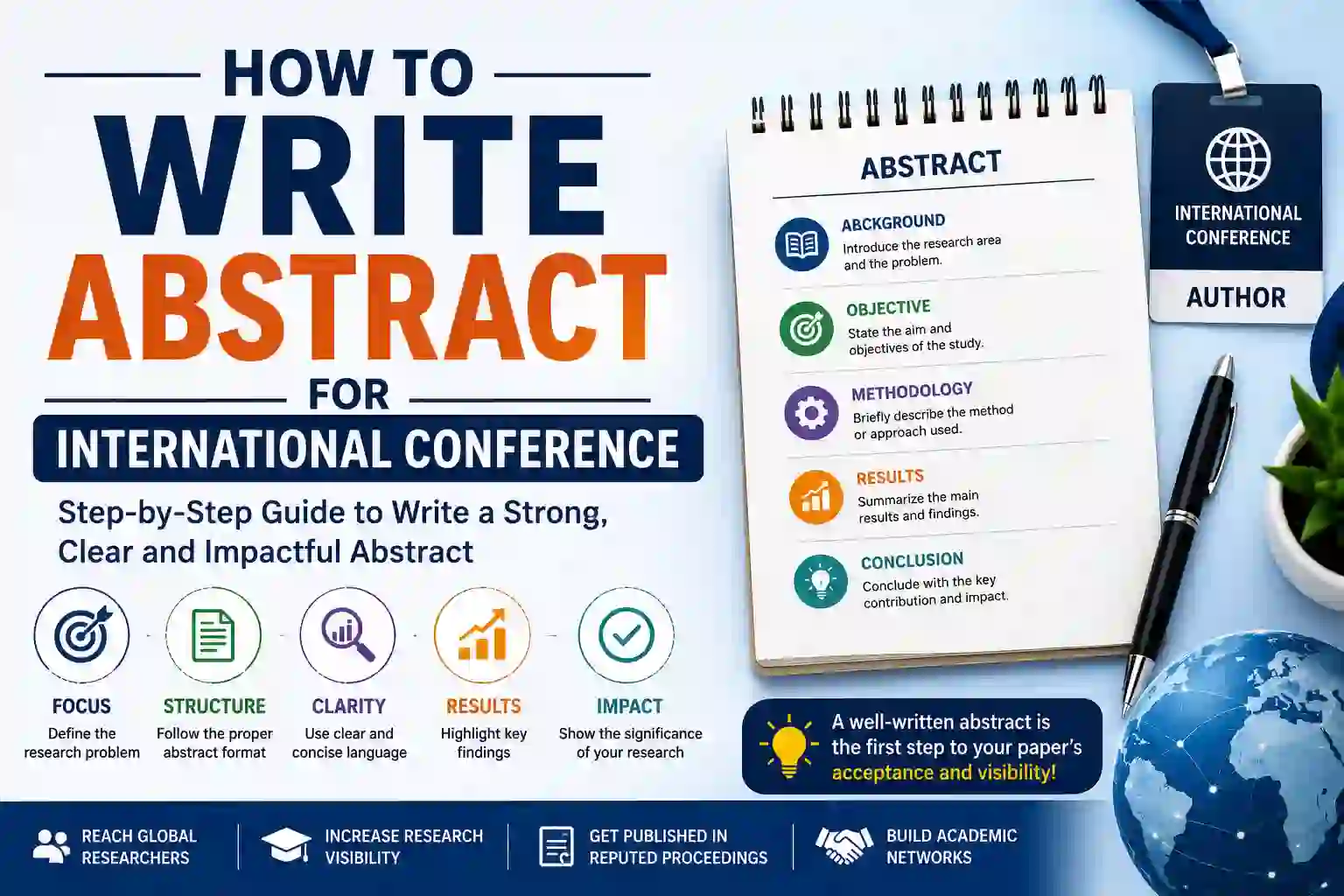
Writing a strong abstract is one of the most important steps in conference paper submission. In most international conferences, the abstract is the first section reviewers read before evaluating the full research paper. A well-written abstract increases the chances of paper acceptance, improves research visibility, and creates a strong first impression among conference reviewers, editors, and researchers.
Many researchers, students, academicians, and scientists struggle to prepare a professional conference abstract because it requires summarizing the entire research work within a limited word count while maintaining clarity, originality, and technical quality.
Researchers looking for conference publication opportunities can explore ICETMS International Conference Platform .
What Is an Abstract in an International Conference Paper?
An abstract is a short summary of a research paper that explains the main objective, methodology, results, and conclusion of the study. Conference organizers and reviewers use abstracts to evaluate the relevance and quality of submitted research papers.
A conference abstract helps:
- Explain the research problem
- Highlight the novelty of the study
- Summarize the methodology
- Present key findings
- Show the importance of the research
Strong abstracts improve conference paper acceptance and attract academic attention during international conferences.
Researchers interested in publication opportunities can also explore Conference Paper Publication .
Why Is the Abstract Important for Conference Paper Submission?
The abstract acts as a gateway to your research paper. In many cases, reviewers decide whether the paper fits the conference scope based on the abstract quality alone.
A high-quality abstract:
- Improves reviewer understanding
- Increases paper acceptance chances
- Enhances research visibility
- Improves indexing and discoverability
- Attracts researchers with similar interests
- Supports academic networking opportunities
Researchers can understand more about conference visibility through International Conference Website Research Visibility and Academic Networking .
Standard Structure of a Conference Abstract
Most international conference abstracts follow a structured format to ensure clarity and readability.
1. Research Background or Problem Statement
Begin by introducing the research topic and explaining the problem your study addresses.
Example:
“Artificial Intelligence is increasingly used in healthcare systems to improve disease prediction and medical diagnosis.”
2. Research Objective
Clearly explain the purpose and goals of your research work.
Example:
“This study aims to develop a machine learning model for early disease prediction using healthcare datasets.”
3. Methodology
Briefly explain the methods, techniques, tools, or experiments used in the research.
Mention:
- Algorithms
- Experimental setup
- Datasets
- Research methods
- Statistical analysis
4. Results and Findings
Summarize the most important research findings and technical outcomes.
Example:
“The proposed model achieved higher prediction accuracy compared to traditional classification techniques.”
5. Conclusion
Conclude with the significance and impact of the research work.
Example:
“The study demonstrates the potential of AI-based healthcare systems for improving early diagnosis and clinical decision-making.”
Ideal Length of a Conference Abstract
Most international conferences require abstracts between:
- 150 to 300 words
- Structured and concise writing
- Clear technical explanation
- Relevant keywords
Always follow the conference author guidelines before submission.
Researchers can explore submission guidelines through the Call for Papers section.
Tips for Writing a Strong Conference Abstract
Use Simple and Clear Language
Avoid overly complicated sentences and unnecessary technical jargon. Clear writing improves reviewer understanding.
Focus on Originality
Highlight the novelty and contribution of your research clearly.
Include Important Keywords
Use relevant research keywords naturally within the abstract to improve search visibility and indexing.
Write the Abstract After Completing the Paper
Writing the abstract after finalizing the research paper helps summarize the work more accurately.
Avoid Citations in the Abstract
Most conferences do not allow references or citations inside abstracts.
Proofread Carefully
Grammar mistakes, spelling errors, and unclear sentences create a poor reviewer impression.
Common Mistakes While Writing Conference Abstracts
Many conference abstracts fail because of avoidable mistakes such as:
- Writing vague objectives
- Missing research results
- Using excessive technical jargon
- Ignoring conference themes
- Poor grammar and formatting
- Submitting copied or plagiarized content
- Using very long sentences
Researchers can understand additional submission errors through 10 Common Mistakes in Conference Paper Submission .
How Abstracts Affect Reviewer Decisions
Reviewers often evaluate conference abstracts based on:
- Research originality
- Technical clarity
- Research relevance
- Innovation and contribution
- Methodology quality
- Presentation and writing style
A strong abstract creates a positive first impression and increases reviewer confidence in the research paper.
Researchers can also learn how to handle review feedback through How to Respond to Reviewer Comments for Conference Papers .
Conference Abstracts in Artificial Intelligence and Computer Science
In highly competitive fields such as Artificial Intelligence, Machine Learning, Data Science, and Computer Science, abstracts must clearly demonstrate:
- Technical innovation
- Algorithm performance
- Experimental validation
- Comparative analysis
- Research significance
Researchers interested in AI and Machine Learning publication opportunities can explore Artificial Intelligence and Machine Learning Conference Research Publication .
Conference Paper Submission Process After Writing the Abstract
After preparing the abstract and final paper, authors usually submit their manuscripts through conference management systems such as CMT.
Before submission:
- Review conference formatting guidelines
- Check plagiarism requirements
- Verify author details
- Prepare keywords carefully
- Ensure PDF formatting compatibility
Researchers can understand the complete submission process through Step-by-Step Guide to Submit Conference Paper Using CMT .
Conference Papers vs Journal Papers Abstract Writing
Conference paper abstracts and journal paper abstracts have some important differences.
Conference abstracts usually:
- Focus on emerging research
- Are shorter and concise
- Highlight innovation quickly
- Support conference presentation selection
Journal abstracts generally:
- Include more technical detail
- Focus on comprehensive analysis
- Discuss broader research implications
- Support long-term publication indexing
Researchers can understand these differences through Conference Paper vs Journal Paper: Key Differences .
Innovation and Multidisciplinary Research Conferences
Modern international conferences encourage innovation and multidisciplinary collaboration across engineering, science, healthcare, technology, management, and education.
Innovation-focused researchers can explore Innovation in Science and Technology International Conference and Research Publication .
Conclusion
Understanding how to write an abstract for an international conference is essential for successful conference paper publication and academic visibility. A professional abstract clearly summarizes the research objective, methodology, results, and significance while maintaining clarity and originality.
By following a structured format, avoiding common mistakes, and aligning the abstract with conference themes, researchers can significantly improve paper acceptance chances and strengthen their academic reputation in international research communities.