











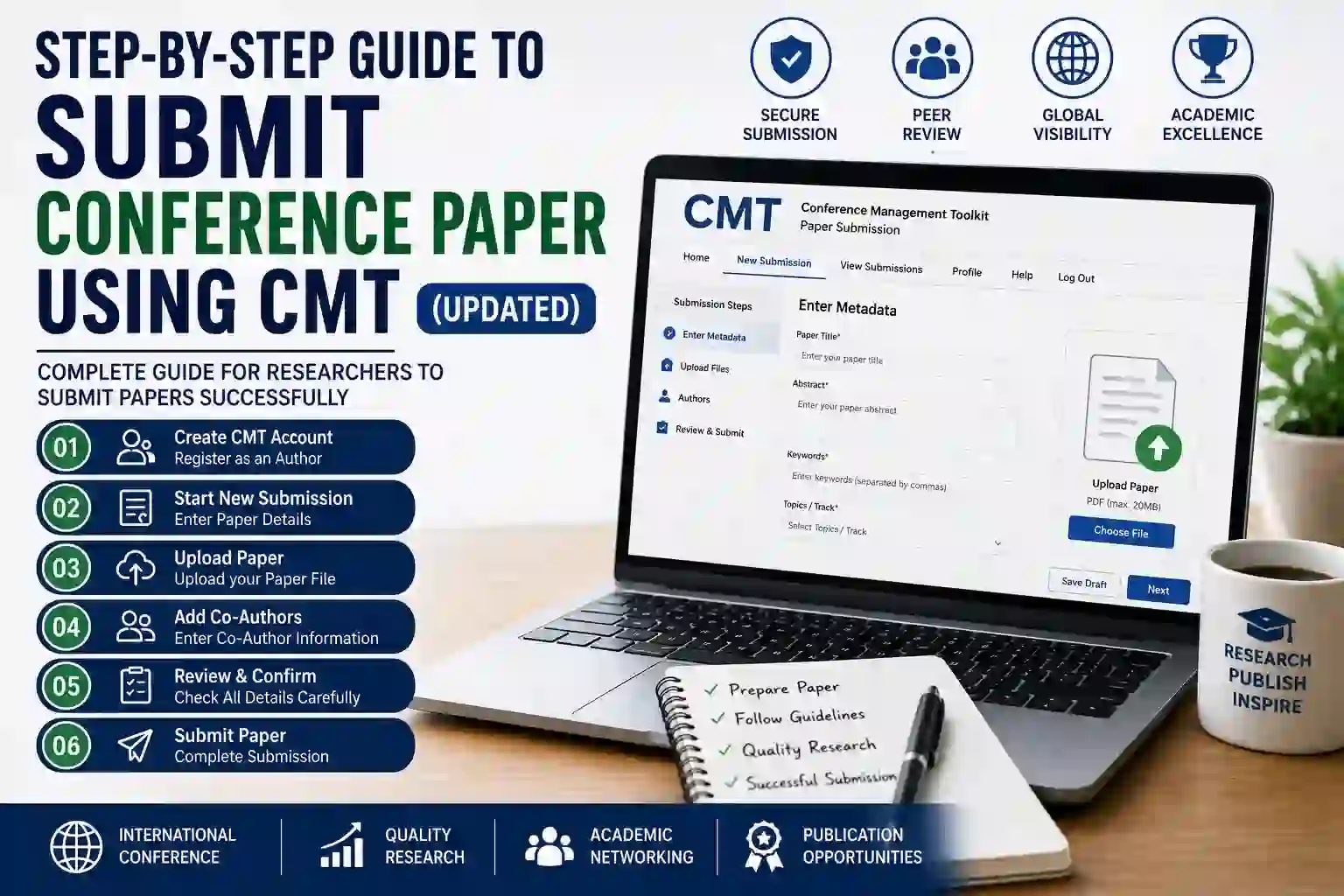
Submitting a research paper to an international conference has become easier with online conference management systems such as Microsoft CMT (Conference Management Toolkit). Many international conferences, academic conferences, engineering conferences, and Artificial Intelligence conferences use CMT for paper submission, peer review management, and conference communication.
This updated step-by-step guide explains how researchers, students, academicians, scientists, and engineers can successfully submit conference papers using the Microsoft CMT platform while avoiding common submission mistakes.
Researchers looking for conference publication opportunities can explore ICETMS International Conference Platform .
Microsoft CMT (Conference Management Toolkit) is an online platform used by conferences and journals to manage:
CMT is widely used in:
Conference organizers prefer Microsoft CMT because it simplifies the complete research publication workflow. The system provides:
Researchers interested in conference publication processes can also read Conference Paper Publication .
Before submitting your paper through CMT, carefully review the conference website and submission guidelines.
Check important details such as:
Researchers can explore upcoming submission opportunities through the Call for Papers section.
To submit a conference paper, authors must first create an account on the Microsoft CMT platform.
During registration:
Using accurate author information is important for future conference communication and publication records.
After creating an account, authors receive access to the conference submission portal through the official conference website or submission link.
Before proceeding:
Researchers should always verify authentic conference platforms before submission through International Conference Website for Conference Paper Publication .
Before uploading the paper, ensure that the manuscript follows all conference formatting and publication guidelines.
Authors should verify:
Researchers can also explore How to Publish Conference Papers for detailed preparation guidance.
Once the manuscript is ready, authors must enter complete paper details into the CMT submission form.
Typical submission information includes:
Choosing accurate keywords improves reviewer assignment and conference topic classification.
Authors can now upload the research paper file in PDF or conference-specified format.
Before final upload:
Uploading the correct final version reduces the chances of administrative rejection.
Many conference papers include multiple authors from different institutions or research groups.
Ensure:
Incorrect author information can create publication and indexing issues later.
Before clicking the final submit button, review all information carefully.
Verify:
Small submission errors can sometimes delay review or affect paper acceptance.
After completing all submission fields, authors can finalize the conference paper submission.
Once submitted:
Always save the submission confirmation email and paper ID for future reference.
After submission, conference reviewers evaluate the paper and may request revisions before final acceptance.
Reviewer comments commonly focus on:
Researchers can understand professional revision strategies through How to Respond to Reviewer Comments for Conference Papers .
The submission process for conference papers and journal papers differs in terms of review timelines, publication requirements, and research depth.
Conference papers generally:
Journal papers usually:
Researchers can understand these differences through Conference Paper vs Journal Paper: Key Differences .
Submitting papers through international conferences provides researchers with opportunities to:
Researchers can understand more about academic networking through International Conference Website Research Visibility and Academic Networking .
Many Artificial Intelligence, Machine Learning, Data Science, and Computer Science conferences use CMT because these fields require efficient management of large research submissions and peer review activities.
Researchers interested in AI and ML conference publication can explore Artificial Intelligence and Machine Learning Conference Research Publication .
Modern international conferences increasingly encourage interdisciplinary collaboration across science, engineering, healthcare, technology, education, and social sciences.
Innovation-focused researchers can explore Innovation in Science and Technology International Conference and Research Publication .
Careful preparation improves the chances of successful publication and smooth conference communication.
Understanding the step-by-step process to submit conference papers using CMT helps researchers avoid submission errors and improve publication success. Microsoft CMT simplifies conference paper management, peer review, author communication, and conference administration for international academic conferences.
By carefully following submission guidelines, preparing high-quality manuscripts, and responding professionally to reviewer comments, researchers can successfully publish conference papers and improve global research visibility, academic networking, and professional growth.