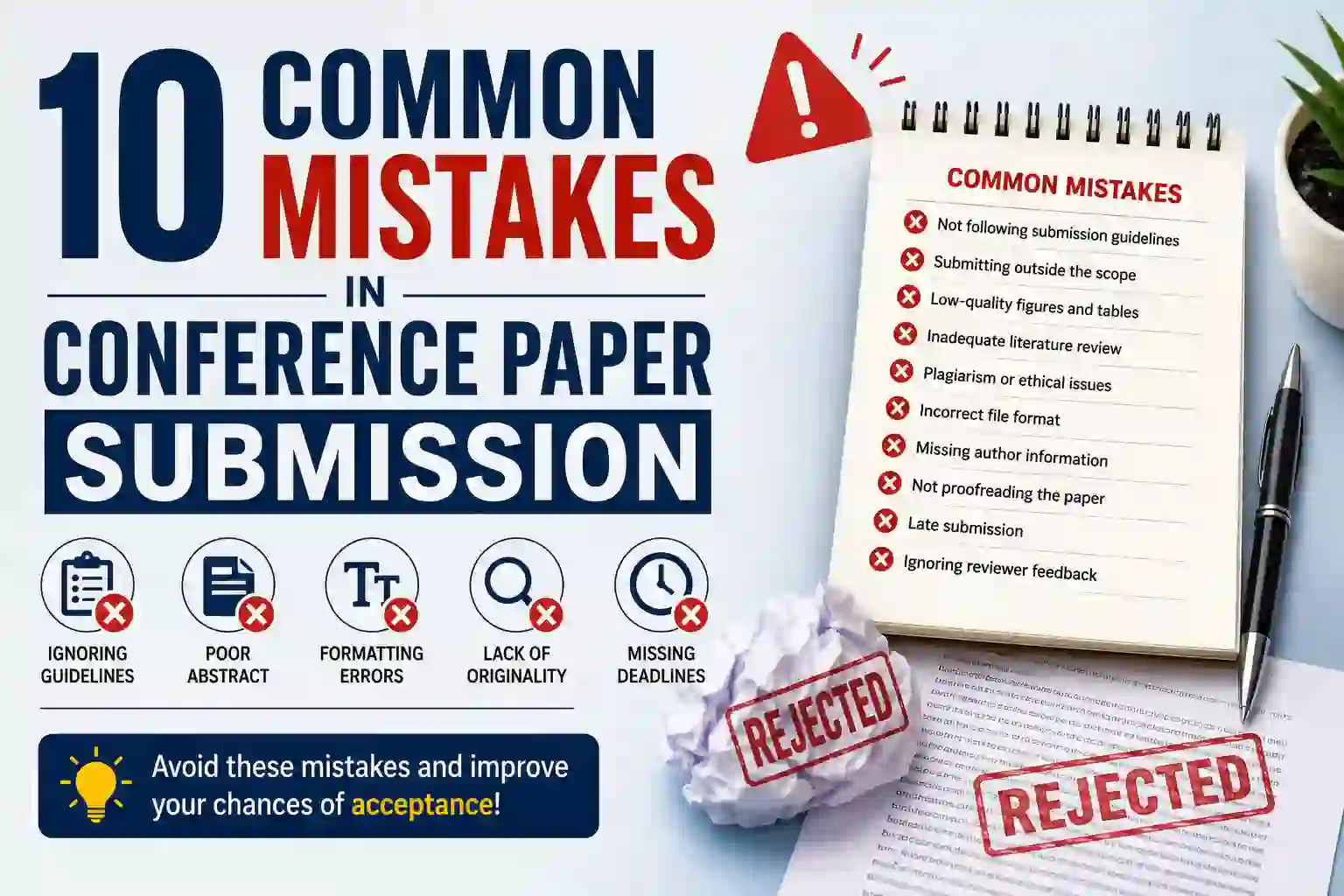
Submitting a research paper to an international conference is an important milestone for researchers, academicians, scientists, engineers, and students. However, many conference papers face rejection due to avoidable mistakes during the submission and review process. Understanding the most common mistakes in conference paper submission can significantly improve publication success and increase the chances of acceptance in reputed international conferences.
Conference paper publication requires careful planning, proper formatting, originality, technical accuracy, and professional communication with conference organizers and reviewers.
Researchers looking for international conference opportunities can explore ICETMS International Conference Platform .
Why Avoiding Submission Mistakes Is Important
Even high-quality research can face rejection if authors ignore conference guidelines, formatting requirements, or peer review expectations. Submission mistakes can affect:
- Paper acceptance chances
- Reviewer evaluation
- Research credibility
- Conference presentation opportunities
- Publication quality
- Academic reputation
Researchers interested in publication opportunities can also explore Conference Paper Publication .
1. Ignoring Conference Submission Guidelines
One of the biggest mistakes researchers make is not reading the conference author guidelines carefully.
Every international conference has specific requirements related to:
- Paper formatting
- Page limits
- Reference style
- File format
- Template usage
- Submission deadlines
Ignoring these instructions can lead to automatic rejection before peer review.
Researchers can understand proper submission practices through How to Publish Conference Papers .
2. Submitting Plagiarized or Non-Original Content
Conference organizers and reviewers strictly evaluate originality and research ethics. Papers containing copied content, poor citations, or plagiarism violations are usually rejected immediately.
Authors should:
- Write original content
- Use proper citations
- Avoid copied text
- Check plagiarism before submission
- Follow ethical publication standards
Original research improves academic credibility and publication quality.
3. Choosing an Irrelevant Conference
Many researchers submit papers to conferences unrelated to their research domain. This creates poor reviewer alignment and reduces acceptance chances.
Before submission:
- Review conference themes carefully
- Check conference topics
- Verify research relevance
- Select appropriate technical tracks
Researchers can explore authentic conference platforms through International Conference Website for Conference Paper Publication .
4. Weak Abstract and Keywords
The abstract is often the first section reviewers read. A poorly written abstract creates a negative impression even before full paper evaluation.
Common abstract mistakes include:
- Unclear research objectives
- Missing methodology explanation
- Weak conclusions
- Lack of technical contribution
- Poor keyword selection
Strong abstracts improve reviewer understanding and search visibility in conference proceedings.
5. Poor Formatting and Presentation
Formatting errors make research papers appear unprofessional and difficult to review.
Common formatting mistakes include:
- Incorrect margins and fonts
- Improper citation styles
- Low-quality figures and tables
- Broken equations or references
- Inconsistent headings
Following conference templates carefully improves readability and reviewer experience.
6. Submitting Incomplete Research
Many conference papers fail because the research lacks sufficient technical depth, experimental validation, or clear conclusions.
Before submission, authors should ensure:
- Research objectives are clear
- Methodology is explained properly
- Results are validated
- Conclusions are meaningful
- Future scope is discussed
Incomplete or poorly analyzed research reduces reviewer confidence.
7. Ignoring Reviewer Expectations
Reviewers evaluate papers based on originality, technical quality, relevance, and clarity. Authors who fail to anticipate reviewer expectations often receive negative feedback.
Common reviewer concerns include:
- Lack of novelty
- Weak literature review
- Insufficient references
- Poor methodology explanation
- Missing comparative analysis
Researchers can understand how to handle reviewer feedback through How to Respond to Reviewer Comments for Conference Papers .
8. Missing Submission Deadlines
Conference submission deadlines are strict. Late submissions are usually not accepted.
Authors should:
- Track conference timelines carefully
- Prepare papers early
- Avoid last-minute submissions
- Allow time for revisions
- Verify timezone differences for deadlines
Researchers can explore current conference submission opportunities through the Call for Papers section.
9. Incorrect Author Information
Incorrect author names, affiliations, or email addresses can create publication and indexing issues after acceptance.
Before submission:
- Verify author order carefully
- Check institutional affiliations
- Confirm email addresses
- Review corresponding author details
Accurate metadata is important for conference proceedings and citation indexing.
10. Failing to Proofread the Final Paper
Grammar mistakes, spelling errors, broken references, and inconsistent formatting reduce paper quality and professionalism.
Before final submission:
- Proofread the complete manuscript
- Check grammar and spelling
- Verify citations and references
- Review figures and tables
- Test PDF formatting compatibility
Professional proofreading improves reviewer experience and overall publication quality.
Conference Paper Submission in Artificial Intelligence and Computer Science
Fields such as Artificial Intelligence, Machine Learning, Computer Science, and Data Science often involve highly competitive conference submission processes.
Reviewers in these domains commonly evaluate:
- Algorithm performance
- Novelty of methods
- Experimental accuracy
- Dataset validation
- Technical implementation quality
Researchers interested in AI and ML publication opportunities can explore Artificial Intelligence and Machine Learning Conference Research Publication .
Conference Papers vs Journal Papers Submission Standards
Conference paper submission standards differ from journal publication requirements in terms of review timelines, formatting, and technical depth.
Conference papers usually:
- Focus on emerging research
- Require shorter submission timelines
- Include presentation opportunities
- Encourage academic networking
Journal papers generally:
- Require detailed technical analysis
- Include extensive peer review
- Need comprehensive methodology
- Demand stronger validation and citations
Researchers can understand these differences through Conference Paper vs Journal Paper: Key Differences .
Importance of Research Visibility and Academic Networking
International conferences not only provide publication opportunities but also help researchers improve academic networking, collaboration, and global research visibility.
Conference participation supports:
- Knowledge sharing
- Professional development
- International collaboration
- Research recognition
- Industry interaction
Researchers can understand more about conference visibility through International Conference Website Research Visibility and Academic Networking .
Innovation and Multidisciplinary Research Conferences
Modern conferences increasingly support multidisciplinary collaboration across engineering, science, healthcare, technology, education, and social sciences.
Innovation-focused researchers can explore Innovation in Science and Technology International Conference and Research Publication .
Conclusion
Understanding the 10 common mistakes in conference paper submission helps researchers improve paper quality, increase acceptance chances, and strengthen academic credibility. Most conference rejections happen because of avoidable issues such as formatting errors, plagiarism, weak abstracts, incomplete research, or missed deadlines.
By carefully following conference guidelines, preparing high-quality manuscripts, proofreading thoroughly, and responding professionally to reviewer feedback, researchers can significantly improve publication success in international conferences and academic research communities.