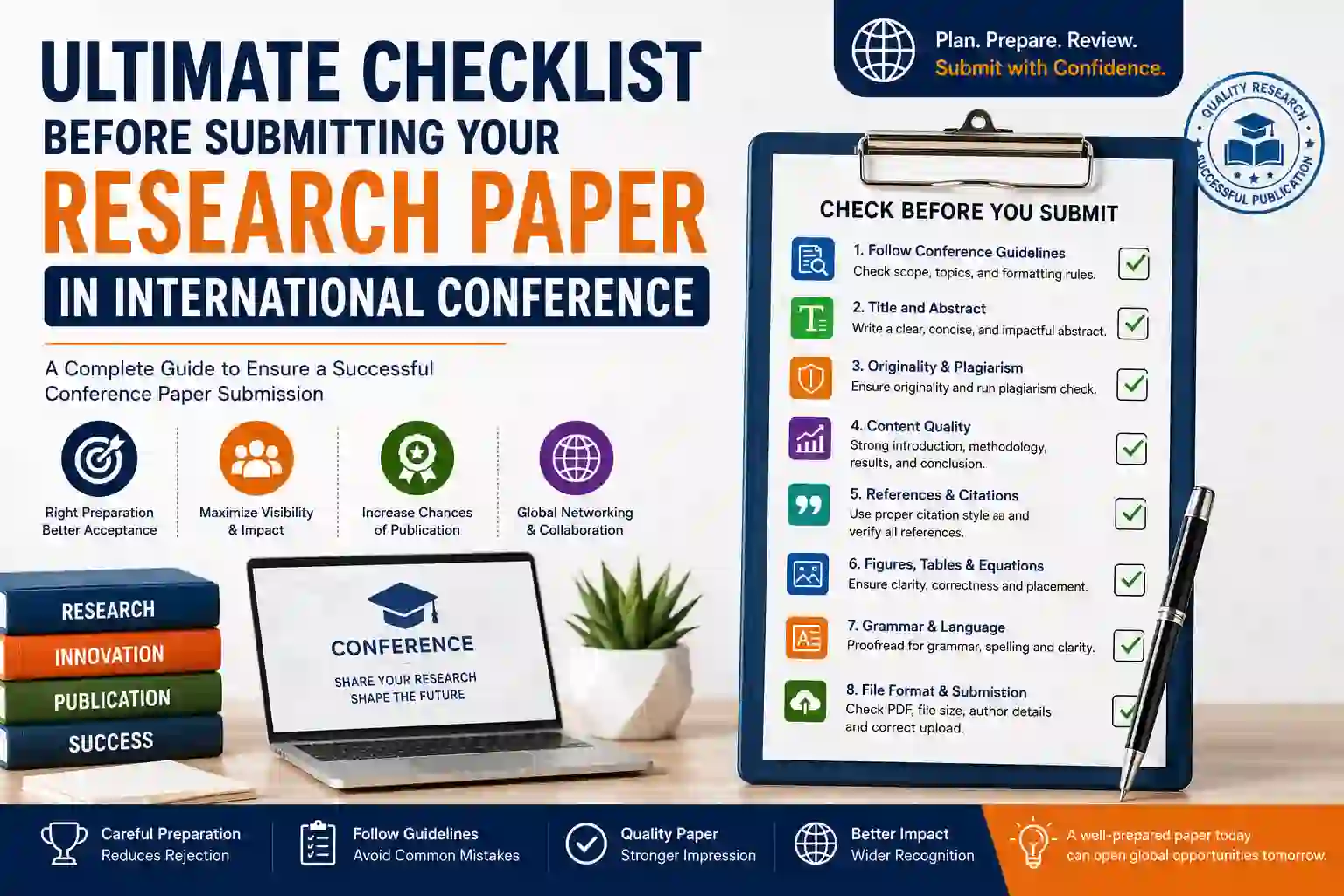
Submitting a research paper to an international conference requires careful preparation, technical accuracy, and strict adherence to conference guidelines. Even high-quality research papers can face rejection because of avoidable mistakes such as formatting errors, incomplete submissions, plagiarism issues, weak abstracts, or missing references.
Following a proper submission checklist helps researchers improve paper quality, reduce reviewer concerns, and increase the chances of conference paper acceptance and publication.
Researchers looking for authentic publication opportunities can explore ICETMS International Conference Platform .
Why a Conference Submission Checklist Is Important
International conferences often receive hundreds or thousands of submissions from researchers worldwide. Reviewers and technical committees evaluate papers carefully based on originality, formatting, technical quality, and research contribution.
A strong pre-submission checklist helps researchers:
- Avoid submission mistakes
- Improve paper presentation
- Meet conference requirements
- Reduce rejection risks
- Increase reviewer confidence
- Enhance publication quality
1. Verify Conference Scope and Topics
Before submission, researchers must confirm that the paper matches the conference themes and technical tracks.
Submitting irrelevant research to the wrong conference is one of the most common reasons for rejection.
Check:
- Conference themes
- Research tracks
- Technical domains
- Publication areas
- Submission guidelines
Researchers can verify authentic conference platforms through International Conference Website for Conference Paper Publication .
2. Review Paper Formatting Guidelines
Every international conference provides formatting instructions that authors must follow carefully.
Formatting usually includes:
- Paper template
- Font size and style
- Page limits
- Reference format
- Figure and table alignment
- Margin specifications
Incorrect formatting can negatively impact reviewer impressions and sometimes lead to desk rejection before peer review.
3. Write a Strong and Clear Abstract
The abstract is one of the most important sections of a conference paper because reviewers often read it first.
A strong abstract should clearly explain:
- Research objective
- Methodology
- Key findings
- Research contribution
- Technical significance
Researchers can improve abstract quality through How to Write Abstract for International Conference .
4. Check Research Originality and Plagiarism
Plagiarism is a major issue in academic publishing and conference paper submission.
Before submission:
- Run plagiarism checks
- Use proper citations
- Avoid copied text
- Rewrite reused content professionally
- Credit all referenced work
Most international conferences use plagiarism detection tools during the review process.
5. Ensure Strong Introduction and Literature Review
The introduction should clearly explain:
- Research problem
- Existing gaps
- Research objectives
- Importance of the study
The literature review should demonstrate awareness of existing research and recent developments in the field.
Proper citations and updated references improve research credibility and reviewer confidence.
6. Validate Methodology and Experimental Results
Conference reviewers carefully evaluate the technical quality of research methodology and experimental validation.
Researchers should verify:
- Algorithm correctness
- Experimental design
- Dataset quality
- Performance analysis
- Graphs and visualizations
- Comparative evaluation
This is especially important in Artificial Intelligence, Machine Learning, Data Science, and Computer Science conferences.
Researchers interested in AI publication opportunities can explore Artificial Intelligence and Machine Learning Conference Research Publication .
7. Write a Strong Conclusion
The conclusion should summarize the research findings and explain the significance of the work clearly and professionally.
A strong conclusion should:
- Summarize key findings
- Highlight research contribution
- Explain practical significance
- Suggest future work
Researchers can improve conclusion writing through How to Write a Strong Conclusion for Conference Paper .
8. Proofread Grammar and Language Carefully
Grammar mistakes, unclear sentences, and poor writing quality can reduce reviewer confidence even if the technical content is strong.
Before submission:
- Proofread multiple times
- Check sentence clarity
- Correct spelling errors
- Improve readability
- Use professional academic language
9. Verify References and Citations
Ensure all references:
- Are properly cited
- Follow conference style guidelines
- Include recent research papers
- Contain accurate publication details
Missing or incorrect references may negatively affect research credibility.
10. Prepare for Reviewer Evaluation
Researchers should evaluate the paper from a reviewer’s perspective before final submission.
Ask:
- Is the research original?
- Are objectives clearly explained?
- Are results validated properly?
- Is the contribution significant?
- Is the writing professional?
Researchers can learn how reviewers evaluate papers through Conference Paper Acceptance Process Explained .
11. Prepare Reviewer Response Strategy
Many conferences request revisions before final acceptance. Researchers should be prepared to respond professionally to reviewer comments.
Professional reviewer responses improve publication success and academic credibility.
Researchers can understand reviewer communication strategies through How to Respond to Reviewer Comments for Conference Papers .
12. Avoid Common Submission Mistakes
Many conference papers get rejected because of avoidable errors during submission.
Common mistakes include:
- Ignoring formatting guidelines
- Submitting incomplete papers
- Weak abstracts
- Plagiarism issues
- Missing references
- Poor grammar
- Low-quality figures
- Incorrect conference selection
Researchers can learn more through 10 Common Mistakes in Conference Paper Submission .
13. Verify Submission Platform Requirements
Most international conferences use online paper submission systems such as Microsoft CMT.
Before final submission:
- Create author profile correctly
- Upload final PDF properly
- Enter keywords accurately
- Verify author information
- Confirm paper category
Researchers can understand the submission workflow through Step-by-Step Guide to Submit Conference Paper Using CMT .
14. Understand Conference Publication Opportunities
Before submission, researchers should review:
- Conference proceedings details
- Publication partners
- Indexing opportunities
- Journal collaboration options
- Research visibility benefits
Researchers can explore publication opportunities through Conference Paper Publication .
15. Build Research Visibility and Academic Networking
International conferences provide opportunities beyond publication, including:
- Global academic networking
- Research collaborations
- Industry interaction
- Knowledge exchange
- Research visibility enhancement
Researchers can understand these benefits through International Conference Website Research Visibility and Academic Networking .
16. Understand Conference Papers vs Journal Papers
Researchers should also understand the difference between conference papers and journal publications before submission.
Conference papers usually:
- Focus on emerging research
- Have shorter review cycles
- Include presentation opportunities
- Support faster publication
Researchers can explore detailed comparisons through Conference Paper vs Journal Paper: Key Differences .
17. Follow Official Call for Papers
Always review the official conference call for papers before submission to verify:
- Submission deadlines
- Conference themes
- Formatting instructions
- Publication information
- Registration policies
Researchers can explore official submission announcements through Call for Papers .
18. Explore Innovation and Multidisciplinary Research Conferences
Modern international conferences increasingly support multidisciplinary research across engineering, science, healthcare, education, management, and emerging technologies.
Researchers interested in innovation-focused publication opportunities can explore Innovation in Science and Technology International Conference and Research Publication .
Final Pre-Submission Checklist
- Conference scope verified
- Formatting completed
- Abstract finalized
- Plagiarism checked
- Grammar proofread
- Figures and tables verified
- References updated
- Conclusion improved
- Submission portal verified
- Reviewer readiness checked
- PDF generated properly
- Deadlines confirmed
Conclusion
Following the ultimate checklist before submitting your research paper in international conference can significantly improve paper quality, reviewer confidence, and publication success. Careful preparation helps researchers avoid common mistakes, strengthen technical presentation, and maximize opportunities for acceptance and academic recognition.
By reviewing formatting, originality, methodology, abstract quality, conclusions, and submission guidelines carefully, researchers can confidently submit professional conference papers to international academic platforms.