











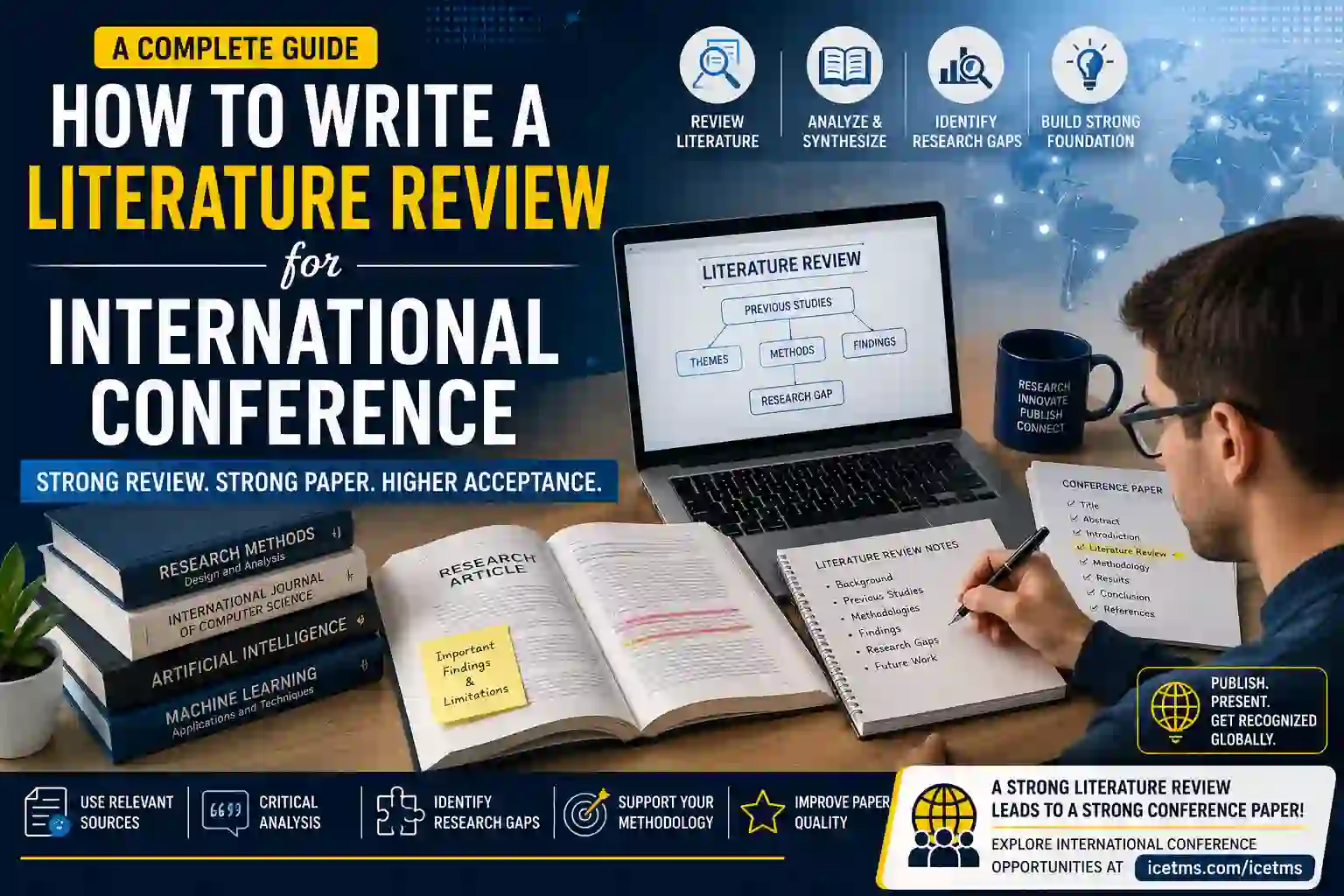
A well-written literature review is one of the most important sections of any conference paper. Whether you are submitting to an international conference in Artificial Intelligence, Machine Learning, Engineering, Management, Healthcare, or Social Sciences, a strong literature review demonstrates your understanding of existing research and highlights the significance of your contribution.
Many conference papers are rejected because authors fail to conduct a comprehensive review of previous studies or clearly explain how their research differs from existing work. Understanding how to write an effective literature review can significantly improve your chances of acceptance and publication.
Researchers seeking publication opportunities can explore ICETMS International Conference Platform.
A literature review is a critical analysis of previously published research related to your topic. Rather than simply summarizing existing studies, a literature review evaluates, compares, and synthesizes research findings to identify gaps, trends, limitations, and opportunities for further investigation.
In conference papers, the literature review helps reviewers understand:
Conference reviewers often evaluate whether authors have sufficient knowledge of existing work before proposing new research. A strong literature review demonstrates academic credibility and helps justify your research objectives.
Benefits include:
Understanding the review process can also help authors prepare stronger submissions. Read Conference Paper Acceptance Process Explained.
Before conducting a literature review, clearly define your research question or problem statement. A focused topic helps identify the most relevant studies and prevents unnecessary information overload.
For example, instead of reviewing all Artificial Intelligence research, focus on a specific area such as:
Researchers working in AI and ML can explore Artificial Intelligence and Machine Learning Conference Research Publication.
A high-quality literature review should be based on credible and recent sources. Researchers should prioritize peer-reviewed publications and reputable conference proceedings.
Useful sources include:
Focus on studies published within the last five years while also including foundational research relevant to your topic.
Instead of discussing studies randomly, organize the literature logically.
Common approaches include:
For conference papers, thematic organization is often the most effective because it highlights research trends and knowledge gaps.
A literature review should not simply list findings from different authors. Instead, compare and evaluate existing studies.
Consider discussing:
This analysis helps demonstrate critical thinking and academic maturity.
One of the most important purposes of a literature review is identifying gaps in current knowledge.
Research gaps may include:
Your conference paper should clearly explain how your work addresses one or more of these gaps.
After discussing previous work, explain how your research contributes to the field.
Clearly answer:
This transition from literature review to research contribution is critical for reviewer evaluation.
Many conference papers contain literature review weaknesses that negatively affect acceptance decisions.
Common mistakes include:
Learn more from 10 Common Mistakes in Conference Paper Submission.
A literature review works best when integrated properly into the overall conference paper structure.
A typical structure includes:
Helpful resources include:
Before submission, review your paper carefully to ensure the literature review:
Use this resource before submission: Ultimate Checklist Before Submitting Your Research Paper in International Conference.
After your paper is accepted, focus on maximizing research visibility through conference presentations and academic networking.
Helpful resources:
A strong literature review is the foundation of a successful conference paper. It demonstrates your understanding of the research landscape, identifies important gaps, and provides the context necessary to justify your contribution.
By systematically reviewing previous studies, critically analyzing existing findings, and clearly connecting your work to current research challenges, you can significantly improve the quality of your conference paper and increase your chances of acceptance at reputable international conferences.
Whether you are preparing your first conference submission or seeking publication in a leading international conference, investing time in a high-quality literature review will strengthen your research and enhance its academic impact.