











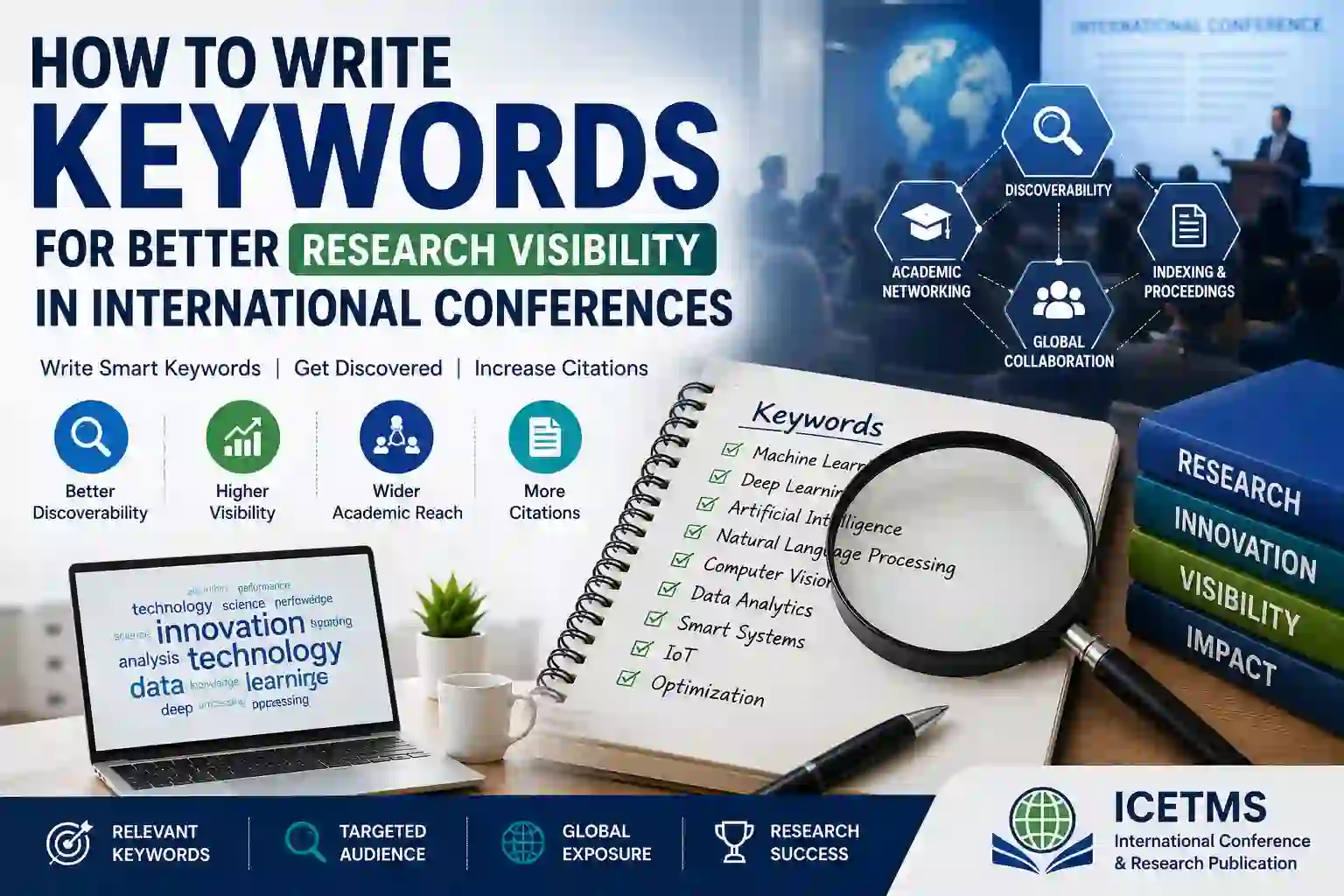
Publishing a research paper in an international conference is only the first step toward academic success. The next challenge is ensuring that your research is easily discoverable by reviewers, researchers, indexing databases, and potential collaborators. One of the most overlooked yet powerful elements of a conference paper is the keywords section.
Well-chosen keywords improve the visibility of your research in conference proceedings, digital libraries, indexing platforms, and search engines. Whether you are submitting a paper in Artificial Intelligence, Machine Learning, Engineering, Healthcare, Management, or Multidisciplinary Research, selecting the right keywords can significantly increase the reach and impact of your work.
Researchers planning to submit their work through an international conference website for conference paper publication should understand how keywords influence discoverability and academic visibility.
Keywords act as the bridge between your research and the people searching for it. Conference organizers, reviewers, indexing databases, and academic search engines use keywords to classify and organize submitted papers.
Benefits of effective keywords include:
Publishing through reputable events such as the ICETMS International Conference becomes more beneficial when authors optimize every aspect of their paper, including keywords.
Keywords summarize the primary concepts, methodologies, technologies, and applications discussed in your paper. They help readers quickly understand the focus of your research and improve search engine discoverability.
Example:
Paper Title: Machine Learning-Based Crop Disease Detection Using Deep Convolutional Neural Networks
Relevant Keywords:
The best keywords originate directly from the problem your research solves. Before selecting keywords, ask yourself:
Example:
Research Topic: Smart Traffic Management Using Artificial Intelligence
Potential Keywords:
Authors working in AI-related domains can explore opportunities through conferences focused on Artificial Intelligence and Machine Learning research publication.
One of the most common mistakes authors make is selecting broad terms that provide little value during indexing and search.
Specific keywords help researchers find your work more accurately and improve your chances of reaching the right audience.
An effective keyword strategy balances primary and secondary terms.
This combination increases visibility across a broader range of academic search queries.
Before selecting keywords, carefully review the conference themes and topics listed in the Call for Papers.
Conference organizers often use these themes to categorize submissions and assign reviewers. Aligning your keywords with conference topics can improve relevance and evaluation accuracy.
Keywords should naturally appear within your abstract and accurately represent your research objectives, methods, and findings.
A well-structured abstract and keyword combination strengthens indexing consistency and improves discoverability.
If you are still preparing your abstract, refer to How to Write an Abstract for an International Conference.
Research trends evolve rapidly, particularly in technology-related disciplines.
Older Terms:
Trending Terms:
Using modern terminology can increase the likelihood that researchers discover your paper through current search trends.
Review recently accepted conference papers and journal articles in your research area. Pay attention to the keywords used by successful authors.
Studying published work helps identify:
Understanding the conference paper acceptance process can also help authors improve submission quality.
Including too many keywords can dilute relevance and reduce effectiveness.
Machine Learning, AI, Deep Learning, Artificial Intelligence, Technology, Research, Data Analytics, Neural Networks, Computer Science
Machine Learning, Deep Learning, Neural Networks, Medical Diagnosis, Predictive Analytics
Most conferences recommend using between 4 and 8 carefully selected keywords.
Consider how researchers might search for studies similar to yours.
| Generic Term | Better Keyword |
|---|---|
| Education | Online Learning Analytics |
| Healthcare | AI-Based Disease Prediction |
| Security | Blockchain Cybersecurity |
Matching real-world search behavior improves research visibility and discoverability.
A comprehensive literature review helps identify frequently used academic terminology and emerging trends within your field.
Researchers can strengthen their keyword strategy by reviewing How to Write a Literature Review for International Conference.
Authors should also avoid the submission issues discussed in Common Mistakes in Conference Paper Submission.
Before submitting your conference paper, verify that your keywords:
For a complete submission review, follow the Ultimate Checklist Before Submitting Your Research Paper in an International Conference.
Strong keywords help your paper become discoverable through:
Researchers looking to maximize visibility should also participate in events that encourage academic networking and research visibility.
Selecting the right keywords is one of the most effective strategies for increasing research visibility in international conferences. Well-crafted keywords improve indexing, help reviewers understand your research focus, increase discoverability, and contribute to long-term citation growth.
Instead of treating keywords as a final submission requirement, researchers should view them as an important component of their publication strategy. Combined with a strong abstract, thorough literature review, proper formatting, and high-quality research, optimized keywords can significantly improve the reach and impact of your conference paper.
For additional guidance on conference publication, explore resources on how to publish conference papers, conference paper publication, and responding to reviewer comments effectively.