











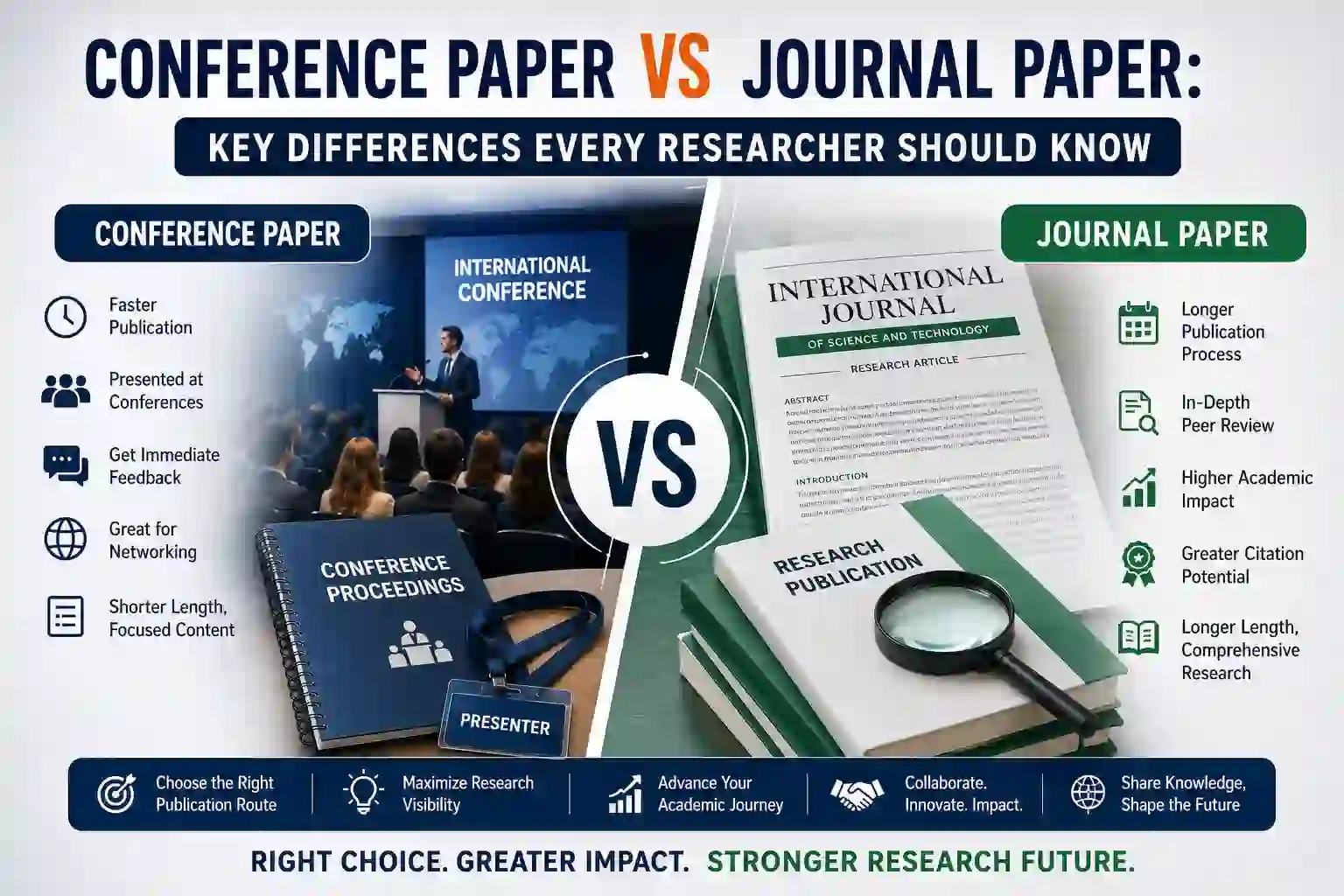
Researchers, academicians, PhD scholars, engineers, scientists, and students often face confusion when deciding between a conference paper and a journal paper for research publication. Both publication formats are important in academic and scientific research, but they serve different purposes, follow different publication processes, and offer different advantages for research visibility and career growth.
Understanding the difference between conference papers and journal papers helps researchers choose the right publication path based on their research goals, subject area, publication timeline, and academic requirements.
Researchers looking for international conference opportunities can explore ICETMS International Conference Platform .
A conference paper is a research paper submitted to an academic or scientific conference for presentation and publication in conference proceedings. Conference papers are commonly presented during international conferences, research conferences, engineering conferences, and computer science conferences.
Conference publications allow researchers to:
Researchers interested in conference publication opportunities can explore Conference Paper Publication .
A journal paper is a detailed and comprehensive research article published in an academic or scientific journal after a rigorous peer review process. Journal publications usually require deeper analysis, extensive experimentation, strong methodology, and detailed results.
Journal papers are often considered highly valuable for:
Researchers searching for multidisciplinary research journals can explore:
| Feature | Conference Paper | Journal Paper |
|---|---|---|
| Publication Speed | Usually faster | Generally slower |
| Review Process | Shorter peer review | Detailed peer review |
| Research Depth | Concise and focused | Detailed and comprehensive |
| Presentation | Presented at conferences | Usually no presentation required |
| Publication Format | Conference proceedings | Academic journals |
| Networking Opportunities | High networking value | Limited networking |
| Publication Timeline | Short submission cycle | Longer publication cycle |
| Research Maturity | Emerging research work | Fully developed research |
Conference papers are ideal when researchers want to:
Conference publications are especially popular in fields such as:
Researchers interested in AI and Machine Learning conferences can read Artificial Intelligence and Machine Learning Conference Research Publication .
Journal papers are more suitable when researchers want to:
Journal publications are highly valuable in multidisciplinary research, scientific research, healthcare, social sciences, and engineering domains.
Both conference papers and journal papers undergo peer review, but the review depth and publication timelines differ significantly.
Authors looking for submission guidance can read How to Publish Conference Papers .
One major advantage of conference publication is direct interaction with researchers, scientists, professors, and industry experts. International conferences provide opportunities for:
Researchers can understand more about conference visibility through International Conference Website Research Visibility and Academic Networking .
International conferences continue to play an important role in scientific communication and technological innovation. Many conferences now publish papers in indexed proceedings and collaborate with reputed journals for extended publication opportunities.
Researchers can explore international conference platforms and publication opportunities through:
Modern research increasingly focuses on interdisciplinary innovation. Researchers from engineering, computer science, healthcare, management, education, and social sciences collaborate through conferences and journals to solve global challenges.
Innovation-focused researchers can explore Innovation in Science and Technology International Conference and Research Publication .
There is no universal answer because both publication formats are valuable in different situations.
Researchers should choose:
In many cases, researchers first publish preliminary findings in conferences and later extend the work into a full journal paper.
Understanding the differences between conference papers and journal papers is essential for researchers planning successful academic publication strategies. Conference papers provide faster publication, networking opportunities, and early research visibility, while journal papers offer detailed peer review, higher academic credibility, and long-term research impact.
Both publication formats contribute significantly to scientific progress and academic growth. By selecting the right publication platform based on research goals and subject area, researchers can maximize research visibility, publication quality, and professional development.