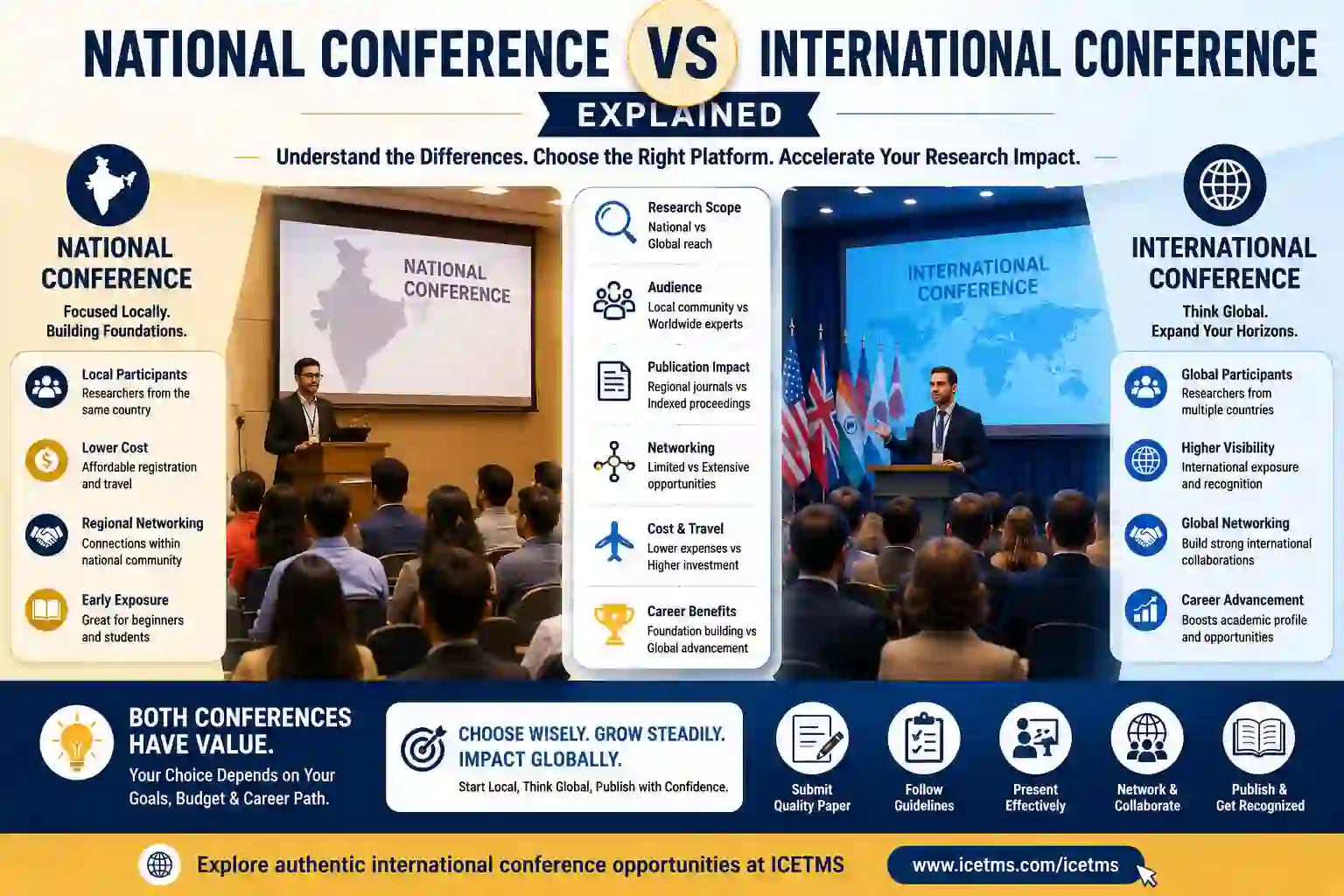
Researchers often face an important question when planning to publish and present their work: should they participate in a national conference or an international conference? Both conference types provide opportunities for knowledge sharing, research dissemination, and professional development, but they differ significantly in scope, audience, networking potential, and academic visibility.
Understanding these differences can help students, scholars, academicians, and industry professionals choose the right conference for their research goals.
Researchers seeking global publication opportunities can explore ICETMS International Conference Platform.
What Is a National Conference?
A national conference is an academic event primarily attended by researchers, faculty members, students, and professionals from a single country. These conferences focus on national research trends, local challenges, and region-specific innovations.
National conferences are often organized by universities, research institutions, professional societies, and academic associations.
Key Characteristics of National Conferences
- Participants mainly belong to one country.
- Lower registration and travel costs.
- Focus on local research challenges.
- Smaller networking environment.
- Suitable for early-career researchers.
What Is an International Conference?
An international conference attracts participants from multiple countries and offers a global platform for presenting research findings. These conferences encourage international collaboration, multidisciplinary discussions, and worldwide academic networking.
Researchers interested in global publication opportunities can explore International Conference Website for Conference Paper Publication.
Key Characteristics of International Conferences
- Global participation.
- International keynote speakers.
- Higher research visibility.
- Broader networking opportunities.
- International collaboration potential.
- Greater academic recognition.
1. Scope and Audience
| Factor | National Conference | International Conference |
|---|---|---|
| Audience | Domestic researchers | Global researchers |
| Research Reach | National level | Worldwide level |
| Collaboration Opportunities | Limited | Extensive |
| Visibility | Regional | International |
International conferences generally provide broader exposure and higher academic recognition compared to national conferences.
2. Research Visibility and Academic Impact
One of the biggest advantages of international conferences is increased research visibility. Researchers can present their work to experts from different countries, institutions, and industries.
Benefits include:
- Higher citation opportunities.
- International recognition.
- Research collaborations.
- Greater professional exposure.
- Improved academic profile.
Researchers can learn more about visibility benefits through Research Visibility and Academic Networking.
3. Networking Opportunities
Networking plays a major role in academic growth.
National Conference Networking
- Connections within the country.
- Regional collaborations.
- Local research discussions.
International Conference Networking
- Global academic contacts.
- Cross-country collaborations.
- Industry-academia partnerships.
- International project opportunities.
For researchers planning long-term academic careers, international networking can be extremely valuable.
4. Conference Paper Publication Opportunities
Publication opportunities vary significantly depending on conference quality.
International conferences often provide:
- Peer-reviewed proceedings.
- Indexed publications.
- Special journal issue opportunities.
- Global readership.
Researchers can learn more through Conference Paper Publication.
5. Cost Comparison
National Conferences
- Lower registration fees.
- Reduced travel expenses.
- Affordable accommodation.
International Conferences
- Higher registration costs.
- International travel expenses.
- Visa requirements.
- Accommodation costs.
While international conferences may require greater investment, they often provide broader professional benefits.
6. Review Standards and Competition
International conferences generally receive submissions from researchers worldwide, making competition more intense.
Reviewers typically evaluate:
- Research originality.
- Technical contribution.
- Methodological quality.
- Practical significance.
- Presentation clarity.
Researchers can understand review procedures through Conference Paper Acceptance Process Explained.
7. Learning Opportunities
International conferences expose participants to diverse perspectives, emerging technologies, and global research trends.
Attendees often gain insights into:
- Artificial Intelligence.
- Machine Learning.
- Engineering innovations.
- Healthcare technologies.
- Education research.
- Multidisciplinary developments.
Researchers interested in AI conferences can explore Artificial Intelligence and Machine Learning Conference Research Publication.
8. Career Development Benefits
Participating in international conferences often strengthens academic resumes and research profiles.
Benefits include:
- Enhanced CV value.
- Global academic recognition.
- Research collaborations.
- Future publication opportunities.
- Professional credibility.
9. Which Conference Should Students Choose?
For first-time researchers, national conferences can provide valuable experience in paper writing, presentation skills, and academic communication.
However, researchers seeking broader visibility should consider international conferences whenever possible.
Before submission, authors should carefully review:
- Conference scope.
- Publication details.
- Indexing information.
- Review process.
- Submission deadlines.
Researchers can prepare effectively using Ultimate Checklist Before Submitting Your Research Paper in International Conference.
10. Tips for Success in International Conferences
- Write a strong abstract.
- Follow formatting guidelines.
- Prepare high-quality presentations.
- Respond professionally to reviewers.
- Network actively with participants.
- Research conference themes carefully.
Helpful resources include:
- How to Write Abstract for International Conference
- Best Practices for Conference Paper Formatting
- How to Prepare a Presentation After Paper Accepted in International Conference
- How to Respond to Reviewer Comments for Conference Papers
Conclusion
The choice between a national conference and an international conference depends on your research objectives, budget, career goals, and publication expectations. National conferences offer valuable learning experiences and local networking opportunities, while international conferences provide greater research visibility, broader collaborations, stronger academic recognition, and worldwide professional exposure.
For researchers aiming to build an international academic profile, participate in global collaborations, and maximize the impact of their work, international conferences often provide the most significant long-term benefits.