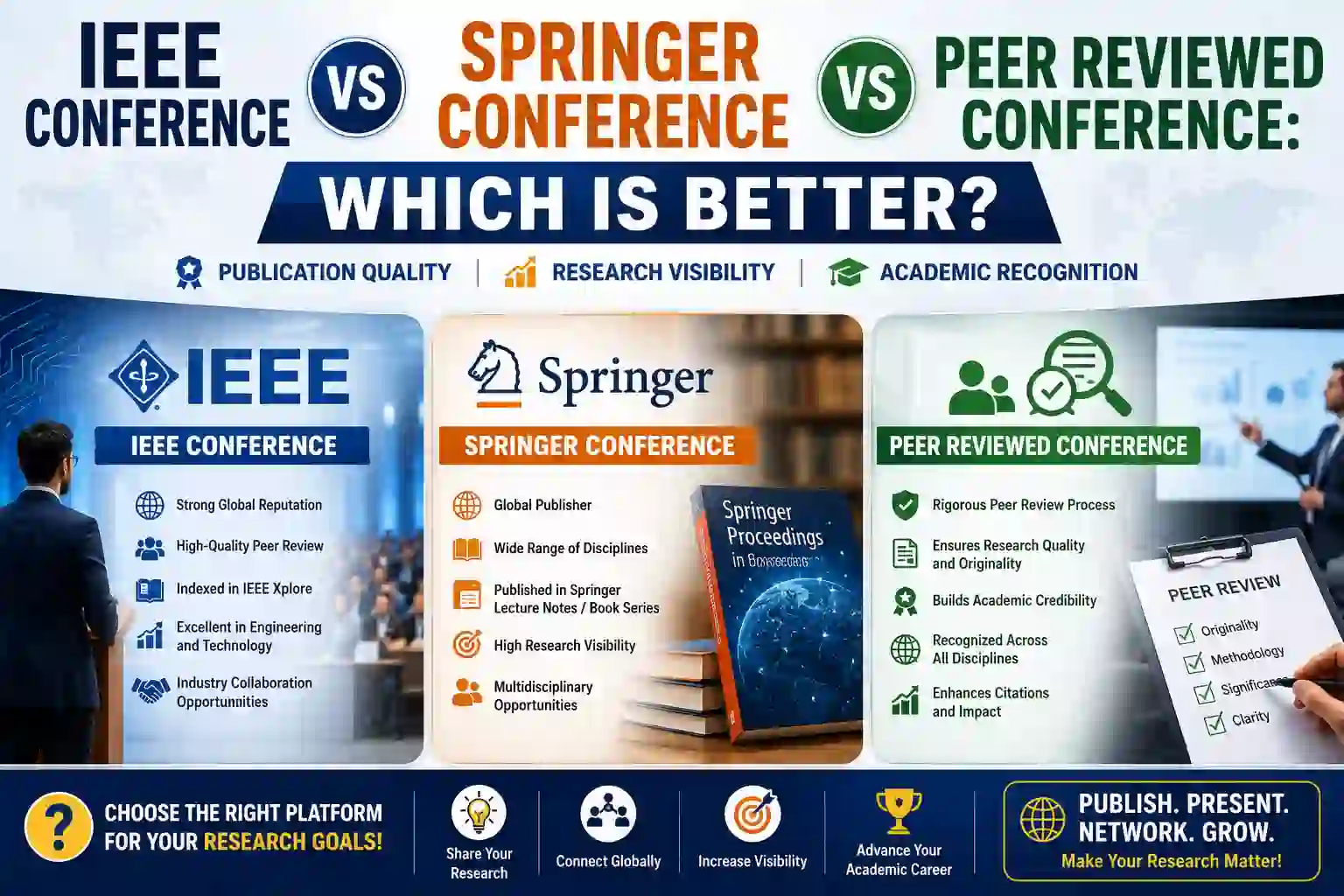
Researchers often encounter terms such as IEEE Conference, Springer Conference, and Peer-Reviewed Conference while searching for publication opportunities. Many authors mistakenly assume that these categories are identical, but each serves a different purpose within academic publishing.
Understanding the differences can help researchers select the most suitable conference for publication, academic recognition, networking, and long-term research impact.
Researchers looking for international publication opportunities can explore ICETMS International Conference Platform.
Understanding Conference Publication Categories
Before comparing conference types, it is important to understand that IEEE and Springer are publication organizations, while peer review refers to the evaluation process used by conferences to assess submitted research papers.
Therefore, IEEE conferences and Springer conferences are generally also peer-reviewed conferences.
What Is an IEEE Conference?
IEEE conferences are conferences whose proceedings are published through IEEE and often indexed within IEEE Xplore. These conferences are highly popular in engineering, computer science, artificial intelligence, electronics, robotics, telecommunications, and information technology.
Advantages of IEEE Conferences
- Strong reputation in engineering and technology.
- High-quality peer-review standards.
- Global academic recognition.
- Excellent networking opportunities.
- Widely cited conference proceedings.
- Strong industry participation.
Best Fields for IEEE Conferences
- Artificial Intelligence
- Machine Learning
- Computer Science
- Software Engineering
- Electrical Engineering
- Data Science
Researchers interested in AI publication opportunities can also explore Artificial Intelligence and Machine Learning Conference Research Publication.
What Is a Springer Conference?
Springer conference proceedings are typically published through Springer conference book series. Springer conferences cover a broad range of disciplines including science, technology, engineering, management, healthcare, education, and multidisciplinary research.
Advantages of Springer Conferences
- Strong international reputation.
- Multidisciplinary conference coverage.
- Global accessibility.
- High research visibility.
- Book chapter style publication opportunities.
- Broad academic audience.
Best Fields for Springer Conferences
- Computer Science
- Engineering
- Management
- Education
- Healthcare Research
- Multidisciplinary Studies
Researchers seeking multidisciplinary opportunities may benefit from Innovation in Science and Technology International Conference and Research Publication.
What Is a Peer-Reviewed Conference?
A peer-reviewed conference is any conference where submitted papers undergo evaluation by independent experts before acceptance.
Peer review helps ensure:
- Research originality.
- Methodological accuracy.
- Technical quality.
- Academic integrity.
- Research significance.
Many international conferences use rigorous peer-review systems regardless of whether they publish through IEEE, Springer, or independent proceedings.
IEEE vs Springer vs Peer-Reviewed Conference Comparison
| Factor | IEEE Conference | Springer Conference | Peer-Reviewed Conference |
|---|---|---|---|
| Primary Focus | Engineering & Technology | Multidisciplinary | Depends on Conference |
| Review Process | Peer Reviewed | Peer Reviewed | Peer Reviewed |
| Global Recognition | Very High | Very High | Varies |
| Networking | Excellent | Excellent | Conference Dependent |
| Research Visibility | High | High | Varies |
| Discipline Coverage | Technology Focused | Broad Coverage | Depends on Scope |
Which Conference Type Is Better for Publication?
The answer depends on your research field and publication goals.
Choose IEEE Conferences If:
- Your research is technology-oriented.
- You work in AI or Computer Science.
- You seek strong engineering visibility.
- You want industry engagement.
Choose Springer Conferences If:
- You conduct multidisciplinary research.
- You work in education or management.
- You seek broader international readership.
- You prefer conference book chapter publications.
Choose Any Strong Peer-Reviewed Conference If:
- The conference has a transparent review process.
- The conference matches your research scope.
- The conference provides quality publication opportunities.
- The conference has strong academic credibility.
Why Peer Review Matters More Than the Label
Many researchers focus exclusively on the publisher name while overlooking review quality. In reality, rigorous peer review often has a greater impact on publication quality than branding alone.
Researchers should evaluate:
- Review transparency.
- Reviewer expertise.
- Conference committee quality.
- Acceptance standards.
- Research scope alignment.
To understand review procedures, researchers can read Conference Paper Acceptance Process Explained.
How to Improve Acceptance Chances
Regardless of conference type, acceptance depends heavily on paper quality.
Researchers should focus on:
- Strong abstracts.
- Proper formatting.
- Clear methodology.
- Well-written conclusions.
- Accurate references.
- Original contributions.
Helpful resources include:
- How to Write Abstract for International Conference
- Best Practices for Conference Paper Formatting
- How to Write a Strong Conclusion for Conference Paper
- 10 Common Mistakes in Conference Paper Submission
Conference Presentation and Research Visibility
Publication is only one aspect of conference participation. Presenting your work effectively can significantly improve research visibility and networking opportunities.
Researchers should prepare carefully before conference presentations.
Useful resources include:
- How to Prepare a Presentation After Paper Accepted in International Conference
- Online vs Offline Conference Presentation Comparison
- Research Visibility and Academic Networking
Final Verdict
There is no single conference category that is universally "better" for every researcher. IEEE conferences are often preferred in engineering and technology disciplines, Springer conferences provide strong multidisciplinary publication opportunities, and high-quality peer-reviewed conferences can offer excellent academic value regardless of publisher.
The best conference is one that aligns with your research area, maintains rigorous peer-review standards, offers meaningful networking opportunities, and helps maximize the visibility and impact of your work.