










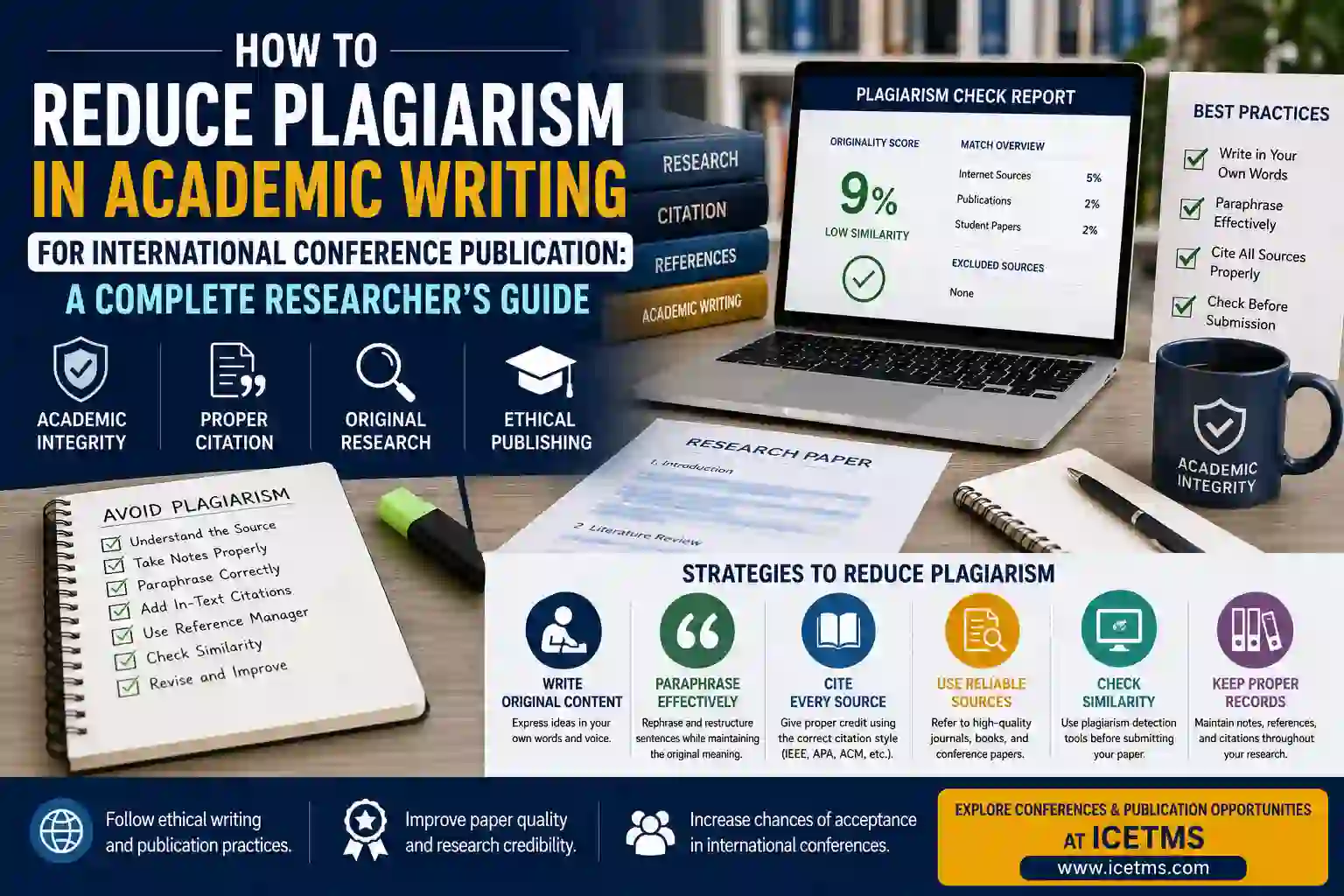
Plagiarism is one of the most common reasons for research paper rejection in international conferences and academic publications. Whether intentional or accidental, plagiarism can damage a researcher's credibility, lead to manuscript rejection, and negatively impact academic careers.
As international conferences continue to emphasize research integrity and ethical publishing practices, authors must ensure that their manuscripts demonstrate originality while properly acknowledging the work of other researchers.
This comprehensive guide explains how to reduce plagiarism in academic writing for international conference publication and provides practical strategies that researchers, PhD scholars, and students can implement before submitting their papers.
If you are planning to publish your research, explore the ICETMS International Conference Platform for upcoming conferences and publication opportunities.
Plagiarism occurs when an author presents someone else's ideas, words, data, images, or research findings as their own without proper acknowledgment.
Academic plagiarism can occur in several forms:
Conference organizers and publishers routinely use plagiarism detection software to evaluate submitted manuscripts before peer review.
Academic publishing is built on trust, transparency, and originality. Conference reviewers expect submitted papers to represent genuine contributions to knowledge.
High plagiarism levels may result in:
Understanding ethical publication practices is essential for researchers seeking successful conference paper publication.
Many plagiarism issues occur unintentionally due to poor writing habits or inadequate citation practices.
Common causes include:
Researchers can avoid many of these issues through proper planning and careful manuscript preparation.
The most effective way to reduce plagiarism is to develop original content from the beginning.
Instead of copying text from published papers:
This approach naturally reduces text similarity while improving your comprehension of the topic.
Paraphrasing involves expressing another author's ideas using your own words and sentence structure while maintaining the original meaning.
Good paraphrasing includes:
Simply replacing a few words with synonyms does not qualify as effective paraphrasing and may still be flagged as plagiarism.
Citations acknowledge the contributions of previous researchers and help readers verify information.
You should cite:
Using proper citation styles such as IEEE, APA, Springer, or ACM significantly reduces plagiarism risks.
Conference papers generally emphasize original analysis and concise writing. Excessive quotations can increase similarity scores and reduce the originality of your manuscript.
Instead of quoting extensively:
Direct quotations should only be used when absolutely necessary.
A comprehensive literature review helps researchers understand existing knowledge and identify research gaps.
When reviewing previous studies:
Researchers can improve this process by following How to Write a Literature Review for an International Conference.
Citation management tools help organize references and reduce accidental citation omissions.
Popular tools include:
These tools automatically generate references according to conference formatting requirements.
AI tools such as ChatGPT, Gemini, and other writing assistants can support academic writing, but researchers must use them responsibly.
Before including AI-assisted content:
Researchers interested in AI-assisted writing may find value in the latest developments in Artificial Intelligence and Machine Learning Research Publication.
Many researchers mistakenly believe they can freely reuse their previously published content.
Self-plagiarism occurs when authors:
If previous work must be referenced, cite it appropriately and clearly explain any new contributions.
Always evaluate your manuscript using plagiarism detection software before submission.
Common plagiarism checking tools include:
Review similarity reports carefully and revise flagged sections when necessary.
Different conferences have different requirements, but many reputable conferences prefer similarity levels below 15% to 20%.
However, similarity percentage alone does not determine plagiarism.
Reviewers also examine:
The abstract is often one of the most scrutinized sections of a conference paper.
Ensure your abstract:
For guidance, read How to Write an Abstract for an International Conference.
Methodology sections often contain technical similarities because researchers describe established methods.
To reduce plagiarism:
Learn more through How to Write a Research Methodology for a Conference Paper.
Researchers often focus on text plagiarism while overlooking visual content.
Always:
Failure to acknowledge visual content may still constitute plagiarism.
Maintaining organized notes throughout the research process helps distinguish your ideas from information obtained from other sources.
Good note-taking practices include:
Proper formatting helps ensure citations, references, and acknowledgments appear correctly.
Researchers should review Best Practices for Conference Paper Formatting before submission.
Before uploading your manuscript:
Researchers should also review the Ultimate Checklist Before Submitting Your Research Paper.
Paraphrasing helps reduce plagiarism, but proper citation is still required when discussing another author's ideas.
AI-generated content may contain similarities or inaccuracies. Researchers should verify, edit, and appropriately disclose AI usage according to conference guidelines.
Many conferences prefer similarity scores below 15–20%, although policies vary among publishers and organizers.
Yes. Reusing previously published content without disclosure can result in paper rejection or publication withdrawal.
Reducing plagiarism is not simply about lowering similarity scores—it is about maintaining academic integrity and contributing original knowledge to the research community. By developing strong writing habits, using proper citations, conducting ethical research, and reviewing manuscripts carefully, researchers can significantly improve their chances of successful international conference publication.
Whether you are preparing your first conference paper or submitting advanced research, prioritizing originality will strengthen both your publication success and academic reputation.
To discover upcoming publication opportunities, visit the Call for Papers page and explore international conferences through ICETMS.